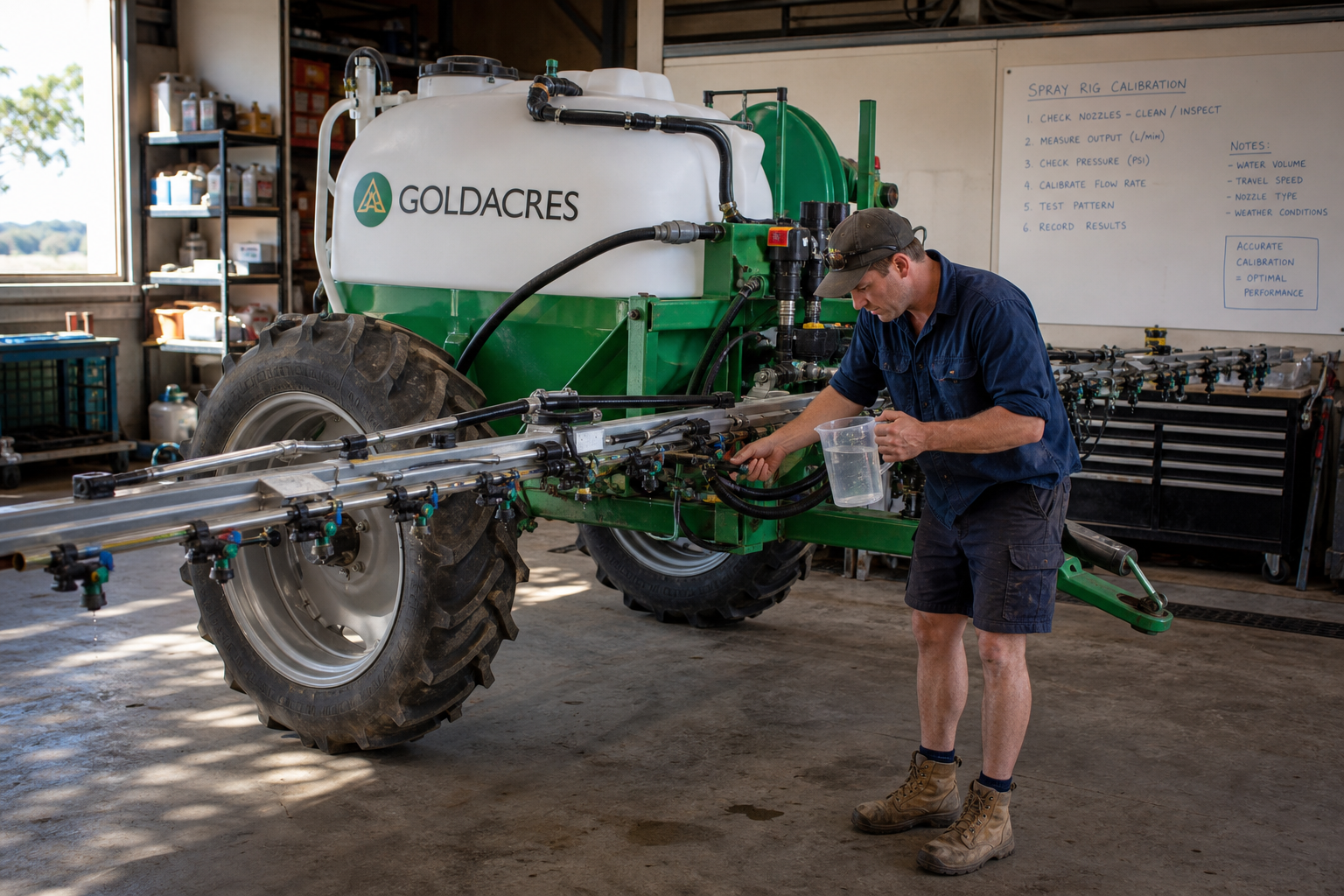
Getting the application rate right — every time
Autumn is the perfect time to calibrate your spray rig for the season ahead. Whether you're applying a knockdown, a residual herbicide, or a selective broadleaf product, poor calibration costs you in three ways: reduced efficacy, crop damage, and wasted chemical.
Why calibration matters
Calibration ensures you are applying the intended litres per hectare (L/ha) at the target droplet size and pressure. Even small errors compound quickly across paddocks:
| Scenario | Error | Consequence |
|---|---|---|
| Under-application | -10% or more | Poor weed control, resistance risk |
| Over-application | +10% or more | Crop stress, residue risk, wasted cost |
| Inconsistent boom output | Variable | Striping and patch failure |
The 4-Step calibration process
Step 1. Check Nozzle Condition
Before measuring anything, inspect your nozzles:
- Confirm all nozzles are the identical type and size.
- Inspect every nozzle for wear and blockage.
- Replace any nozzle that varies more than ±10% from the manufacturer's rated output.
Watch out
Worn nozzles are the most common cause of undetected over-application. When in doubt, replace them — nozzle sets are far cheaper than a failed spray program.
Step 2. Confirm operating pressure
Pressure directly affects droplet size and drift risk. Set it deliberately, not by habit:
- Field spraying typically operates between 2–3 bar (30–45 psi).
- Lower pressure produces coarser droplets — better for reducing drift.
- Higher pressure produces finer droplets — better coverage, but higher drift risk.
Always match your pressure to the product label requirements and the prevailing drift risk conditions on the day.
Step 3. Measure actual nozzle output
Use clean water for this test to avoid contamination and get a true baseline reading:
- Run the sprayer at your intended operating pressure.
- Collect the output from one nozzle for exactly 1 minute into a measuring jug.
- Record the volume in millilitres (mL).
- Repeat the test across several nozzles along the full length of the boom.
Acceptance threshold
All nozzles should be within 10% of each other. Anything outside this range will cause uneven application across the boom — the root cause of striping and patch failure.
Step 4. Calculate your water rate (L/ha)
Once you have a confirmed nozzle output figure, use the standard formula to calculate your actual water rate:
The water rate formula
Water rate (L/ha) = (600 × Nozzle output L/min) ÷ (Speed km/h × Nozzle spacing m)
Worked example
| Nozzle output | 0.8 L/min |
| Travel speed | 8 km/h |
| Nozzle spacing | 0.5 m |
| Result | (600 × 0.8) ÷ (8 × 0.5) = 120 L/ha |
If your result doesn't match your target rate, adjust travel speed or operating pressure — then re-measure to confirm.
Quick Reference Summary
Pre-spray checklist
- Nozzles matched — same type and size across the full boom
- No nozzle varies more than ±10% from rated output
- Pressure set to match product label and conditions
- Water rate calculated and confirmed against target
- Boom height and speed locked in before entering the paddock
How Highlands Ag Solutions can help
- Spray rig calibration reviews and on-farm support
- Herbicide and pesticide program planning
- Resistance management and product selection advice
- Chemical use records and compliance guidance